Free Printable Tracing Sheets
Handwriting worksheet generator
Create printable handwriting practice sheets in seconds: traceable name pages, A–Z alphabet practice in print or cursive, and custom word lists — all on kid-friendly sky, grass, and ground guide lines, with PDF and PNG export.
1 · Content
One name or word per sheet works best. Keep it short for large letters.
2 · Style
Letter style
Line size
Model ink
Paper size
Tracing rows per block
Blank practice rows
3 · Preview & export
Type something to preview your sheet
Preparing your worksheet…
Everything renders in your browser — nothing is uploaded. Print at 100% / “Actual size” so the guide lines match the on-screen size.
Current Output Example
What this focused tool creates
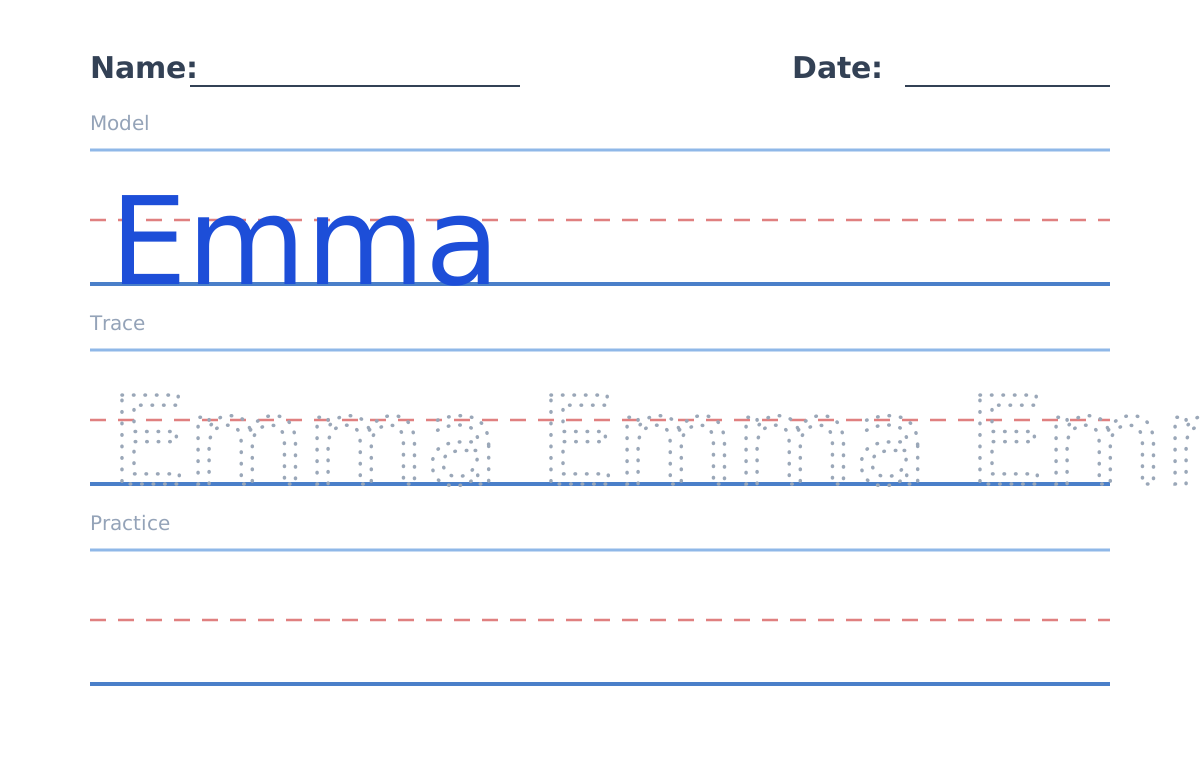
A name-tracing sheet from the generator: solid model row, dotted tracing row, and blank practice row on three-line guides.
- Name, alphabet, and custom word tracing modes
- Print and cursive letter styles
- Sky/grass/ground guide lines with adjustable sizing
- Multi-page PDF and PNG export
Three worksheet types, one generator
Name tracing sheets
Type any name and get a dedicated tracing page: a solid model row to study, dotted rows to trace over, and blank guide rows for independent practice. It is the fastest way to help a child learn to write their own name — the single most motivating first word for most preschoolers and kindergarteners.
A–Z alphabet practice
Generate the full alphabet in uppercase, lowercase, or both, in print or cursive. Each letter flows across model, tracing, and practice rows, so one sheet covers the complete letter set in reading order. It works as a daily warm-up page or as a multi-page practice pack for the whole alphabet.
Custom word lists
Paste up to 60 words — spelling lists, sight words, vocabulary, or names of family members — and every word gets its own model, tracing, and practice block. Because the words are yours, the same sheet doubles as handwriting practice and reading reinforcement.
How to use this tool
- Pick a worksheet type: name tracing, A–Z alphabet, or your own word list.
- Type the name, choose the letter case, or paste words one per line.
- Select print or cursive style, line size, tracing and practice row counts.
- Preview every page, then download the full PDF or the current page as PNG.
Recommended settings
- Beginner name tracing
- Name mode, print style, large lines, 3 tracing rows, 2 practice rows
- Alphabet practice pack
- Alphabet mode, both cases, medium lines, A4 or Letter to match the printer
- Weekly spelling words
- Word list mode, print or cursive, medium lines, export multi-page PDF
Printing and classroom use
Match the A4 or Letter setting to your printer paper and print at 100% (actual size) so the guide lines come out at their true size. For reusable sheets, print once and slip the page into a dry-erase pocket or laminate it, then trace with a dry-erase marker.
Current limitations
The generator renders tracing and practice rows from the text you provide; it does not teach letter formation order, check a child's tracing, or reproduce any specific school handwriting program's letterforms. Review the letter shapes in the preview before printing a class set.
Who it helps
Built for parents, teachers, and homeschoolers
Parents
Make a fresh tracing sheet in under a minute whenever motivation strikes — a name page before school, a few spelling words after dinner. Because each sheet is generated on demand, practice always feels new instead of recycled from the same workbook page.
Teachers
Differentiate without extra prep: large lines and extra tracing rows for beginners, smaller lines and more blank practice rows for confident writers. Print a class set from one word list, with a name-and-date header on every page for easy collecting and filing.
Homeschoolers
Build handwriting into any curriculum by generating sheets from the words you are already studying — science vocabulary, history terms, or this week's reading words. The cursive mode gives you a real path from print to joined writing without buying a separate cursive program.
Tutors and therapists
Target exactly the letters or words a learner struggles with. A short, focused sheet with just the tricky words — practiced a little every day — beats a generic workbook for building letter formation and fine-motor confidence.
Guide lines explained
Sky, grass, and ground: why three lines beat one
A single baseline tells a child where letters sit, but not how tall they should be. That is why this generator draws three kid-friendly guide lines on every row. The top sky line shows where tall letters like b, d, f, h, k, l, and t reach. The dashed grass midline marks the top of small letters like a, c, e, m, n, and o. The solid ground baseline is where every letter rests its feet, with tails like g, j, p, q, and y dipping just below it.
When children can see all three zones, common problems fix themselves: floating letters land on the ground line, oversized small letters shrink to the grass line, and tall letters stop crashing into the row above. If a learner is very new to writing, choose the large line size — bigger zones are more forgiving for developing fine-motor control. As control improves, move to medium and then small lines, which is the same progression most school handwriting programs follow.
You can switch the guides off for a clean look, but keep them on while letter formation is still being learned. Pair the sheets with our guide to making handwriting practice sheets for more ideas on structuring daily practice, and browse blank printable templates when you want plain lined paper without any tracing content.
Printing tips
Get crisp, true-to-size printouts
The preview is rendered at full print resolution, so what you see is what the printer produces — as long as the print dialog cooperates. Always print at 100% or “Actual size” rather than “Fit to page”; scaling shrinks the guide lines and defeats the sizing you chose. Match the A4 or Letter setting here to the paper loaded in the printer before you hit print.
For everyday practice, plain copy paper is fine. If sheets will be handled a lot — or wiped clean in a dry-erase pocket — use slightly heavier paper (around 24 lb / 90 gsm) so it stays flat. Printing in grayscale keeps the dotted tracing lines light and easy to trace over, and it saves color ink. For classroom sets, the multi-page PDF export keeps a whole alphabet or spelling pack in one file that prints in order.
Handwriting practice works best in short, regular sessions: ten focused minutes tracing and copying beats an hour of tired scribbling. If you want to understand why the practice matters, read why handwriting still matters in the digital age, and see all of our free handwriting tools for lined paper, notes, and PDF conversion alongside this worksheet generator.
Privacy
Worksheets are rendered entirely in your browser. Names, words, and generated pages are never uploaded to a HandwritingTool application server. Standard website analytics, hosting, and security services may still process technical usage data.
Frequently asked questions
Is this handwriting worksheet generator free?
Yes. You can create unlimited tracing sheets — names, alphabets, and word lists — and download them as PDF or PNG without creating an account. Everything renders in your browser, so there is nothing to sign up for and no watermark on the output.
What is the difference between print and cursive mode?
Print mode uses clear block letters, which is where most children start. Cursive mode switches the model and tracing letters to a joined, slanted script so older kids can practice flowing letterforms and connections. You can generate the same word list in both styles to bridge the transition from print to cursive.
How do the sky, grass, and ground guide lines work?
Each practice row has three lines. The top sky line marks where tall letters like b, d, and h reach. The dashed grass midline marks the top of small letters like a, e, and n. The solid ground baseline is where every letter sits. Keeping the guides visible gives children a constant visual reference for letter size and placement.
Can I make tracing sheets with my own spelling words?
Yes. Switch to the Word list tab, paste up to 60 words (one per line), and each word gets its own block: a solid model row, dotted tracing rows, and blank practice rows. It is a quick way to turn that week's spelling list or sight words into a printable practice pack.
Which paper size should I choose, A4 or Letter?
Match the paper in your printer. A4 (210 × 297 mm) is standard in most of the world, while Letter (8.5 × 11 in) is standard in the US. Choose the same size here and in your print dialog, and print at 100% or “Actual size” so the guide lines come out at their true size.
How do I reuse a worksheet without reprinting it?
Print the sheet, slide it into a dry-erase pocket or laminate it, and let kids trace with a dry-erase marker. Wipe it clean and it is ready for the next round. This works especially well for name tracing and alphabet sheets that get practiced daily.
Can I use these worksheets in my classroom?
Yes. Teachers and homeschoolers can generate and print as many copies as they need for classroom or home use. The name-and-date header on every page makes it easy to hand out, collect, and file the finished practice.